Quickstart#
Install#
pip install fourierslm
In a conda environment, activate it and run the same command. With uv, use uv add fourierslm. The only
dependencies are numpy and scipy.
Units and conventions#
Everything is in SI units, and angles are in radians.
Fields are in √(W/m²).
slm_fieldmakes \(E = \sqrt{I}\,e^{i\phi}\) from the intensity and the phase, so \(|E|^2\) is the intensity in W/m² on the SLM and in every plane after it. Powers are conserved from the SLM to every plane.For a pulse, give the peak power to the
intensityfunctions,peak_power(energy, duration)for a Gaussian pulse, and \(|E|^2\) is the peak intensity.The plane wave is \(e^{i(kz - \omega t)}\), so a phase that grows along \(+X\) on the SLM moves the focus toward \(+x\). The constant phase \(e^{ikz}\) of the carrier is left out.
Grids are square.
slm_gridgives the coordinates (X, Y) on the SLM,focus_gridthe coordinates (x, y) at the focus, both 1D with the axis on indexn // 2, and fields have the shape(n, n).The widths of the
intensityfunctions are radii of the intensity at 1/e².Fields in complex64 are propagated in complex64, about twice as fast, with errors around 10⁻⁶.
Choosing the grid#
slm_grid(size, n=2048) takes the side of the square and the number of points. The size must hold the beam, at least
4 beam radii for a Gaussian. Then each one sets one thing at the focus, with the default padding of focus_grid.
With the size fixed, the number of points sets the field of view at the focus, \(n\lambda f/(2\,\mathrm{size})\). A bigger field of view needs more points.
With n fixed, the size sets the detail at the focus, \(\lambda f/(2\,\mathrm{size})\). Finer detail needs a bigger size, and 20 times the beam radius gives about \(0.08\,w_0\).
Give pitch instead of size only when the SLM pixels matter, as for stochastic holograms or quantization. Then the
size is n times the pitch, slm_grid(n=2048, pitch=8e-6).
Example#
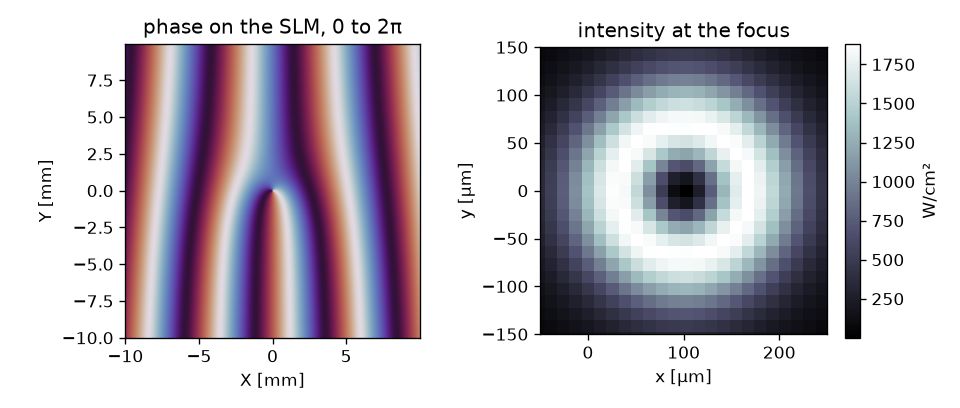
A Gaussian beam of 1 W on a square of 20 mm, a lens of 50 cm, at 1030 nm. The SLM shows a vortex of charge 1 and a grating that moves the focus by 100 µm along \(x\). The focus is a ring with a dark center.
import matplotlib.pyplot as plt
import numpy as np

import fourierslm as fs

lam, f, w = 1030e-9, 0.5, 2e-3
X, Y = fs.slm_grid(size=10 * w)
x, y = fs.focus_grid(X, Y, lam, f)

intensity = fs.intensity.gaussian(X, Y, w, power=1.0)
phase = fs.phase.vortex(X, Y, 1) + fs.phase.grating(X, Y, lam, angle=100e-6 / f)
E_slm = fs.slm_field(intensity, phase)
E_focus = fs.propagate.focus(E_slm, X, Y, x, y, lam, f)

fig, ax = plt.subplots(1, 2)
ax[0].imshow(fs.phase.wrap(phase), extent=[X[0] * 1e3, X[-1] * 1e3, Y[0] * 1e3, Y[-1] * 1e3], origin="lower",
             cmap="twilight", vmin=0, vmax=2 * np.pi)
ax[0].set(xlabel="X [mm]", ylabel="Y [mm]", title="phase on the SLM, 0 to 2π")
im = ax[1].imshow(np.abs(E_focus) ** 2 * 1e-4, extent=[x[0] * 1e6, x[-1] * 1e6, y[0] * 1e6, y[-1] * 1e6],
                  origin="lower")
ax[1].set(xlabel="x [µm]", ylabel="y [µm]", title="intensity at the focus", xlim=(-50, 250), ylim=(-150, 150))
fig.colorbar(im, ax=ax[1], label="W/cm²")
fig.tight_layout()
The user guide explains the setup and the propagators.