Benchmark#
The SFA of hhgsfa is checked against StrongFieldApproximation.jl by S. Carlström, a Julia code for the same model. Both codes run on exactly the same fields, in argon at 1030 nm.
Summary#
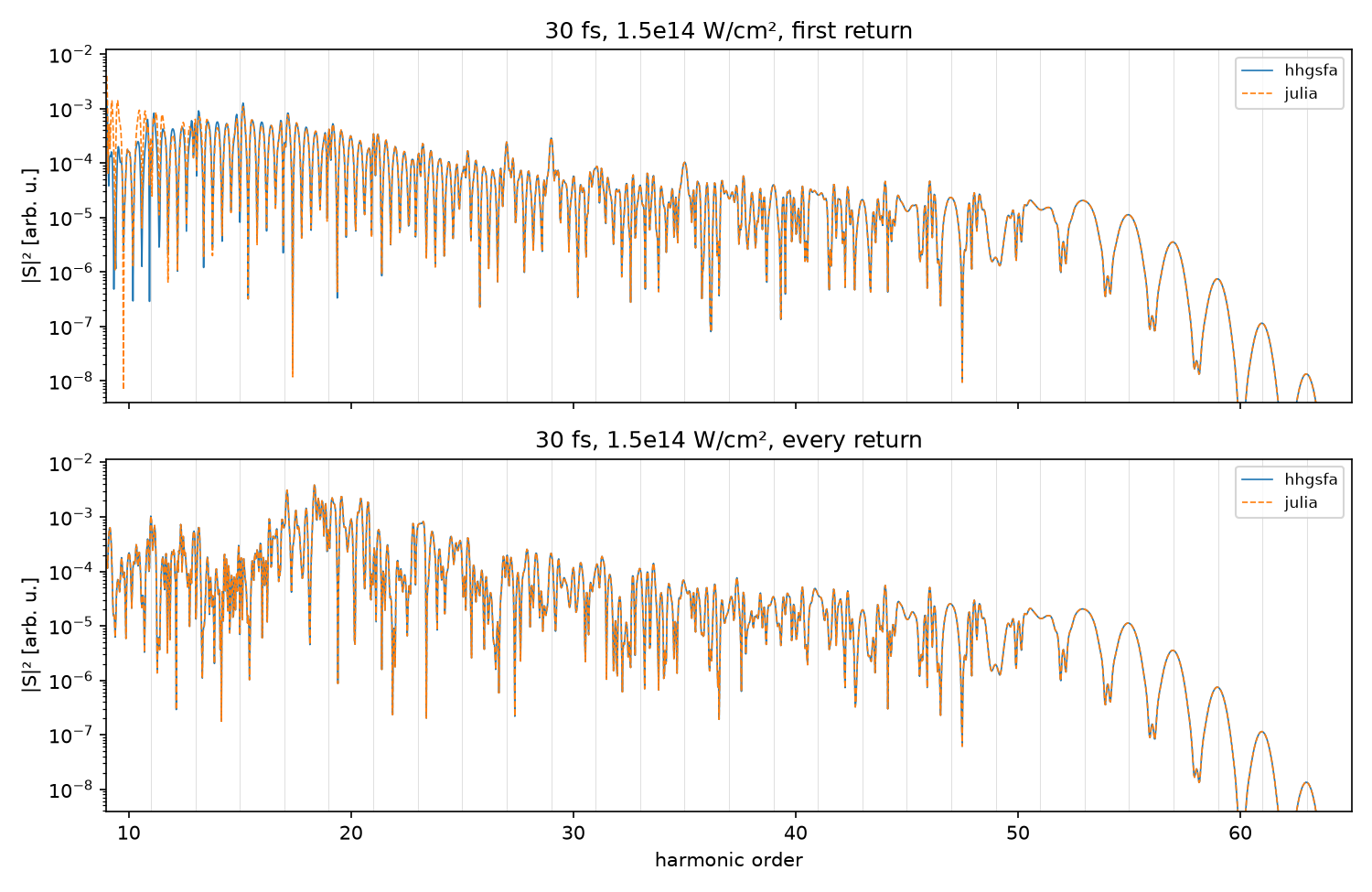
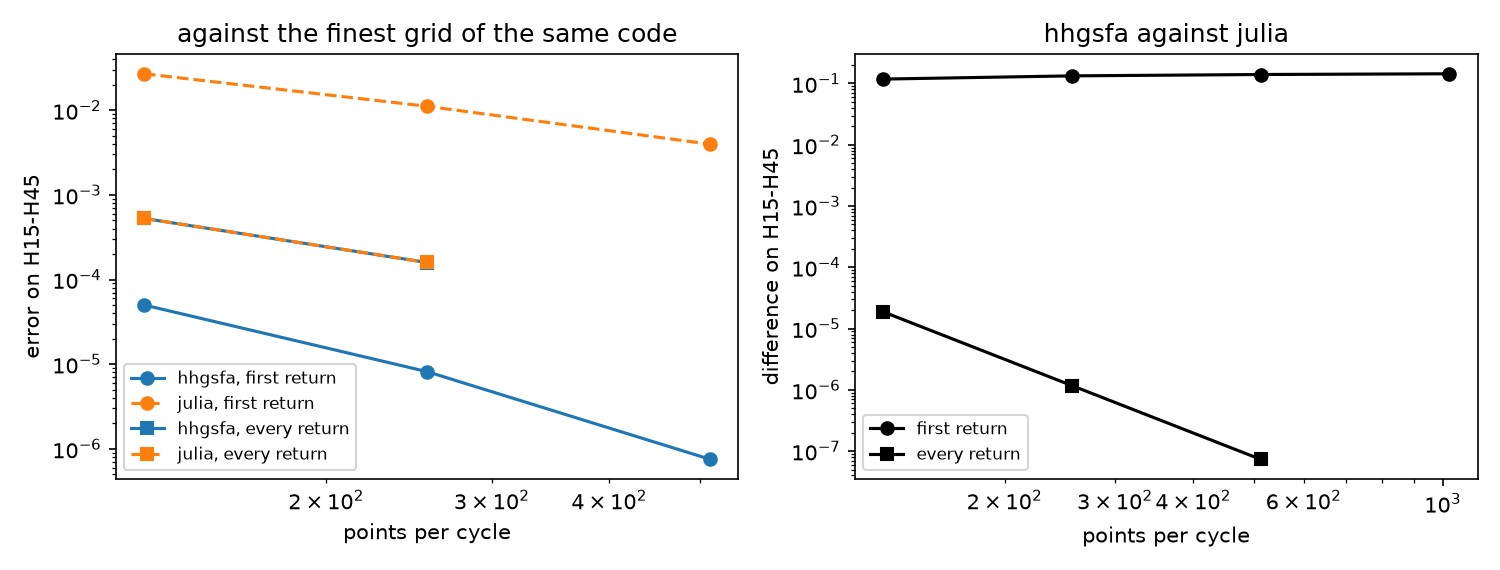
With every return kept, the two codes give the same harmonics, to 2 × 10⁻⁵ at 128 points per cycle and 10⁻⁷ at 512.
With the first return only, they differ by about 13 %, because they cut the long excursions differently. hhgsfa uses a smooth cut, which also converges faster.
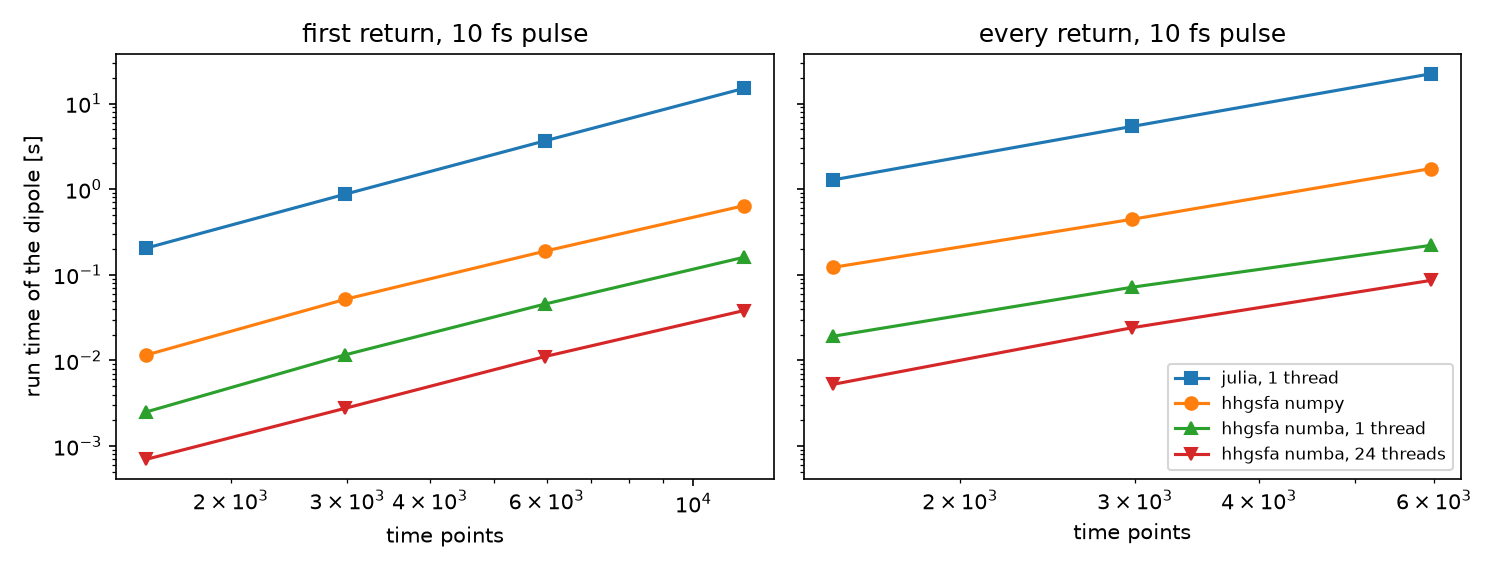
hhgsfa is 10 to 20 times faster with numpy alone, and about 100 times faster with numba on a single core.
Differences#
Both use the Lewenstein model, the saddle-point momentum and a hydrogen-like atom without depletion. They differ in the numerics.
hhgsfa |
StrongFieldApproximation.jl |
|
|---|---|---|
Vector potential and its integrals |
from the sampled field, 4th order |
analytic |
Sum over excursion times |
trapezoid |
rectangle |
First return |
smooth cut at one cycle |
hard cut at one cycle |
Parallel |
yes, with numba |
no |
Figures#
Spectra of a 30 fs pulse at 1.5 × 10¹⁴ W/cm². The two codes lie on top of each other.
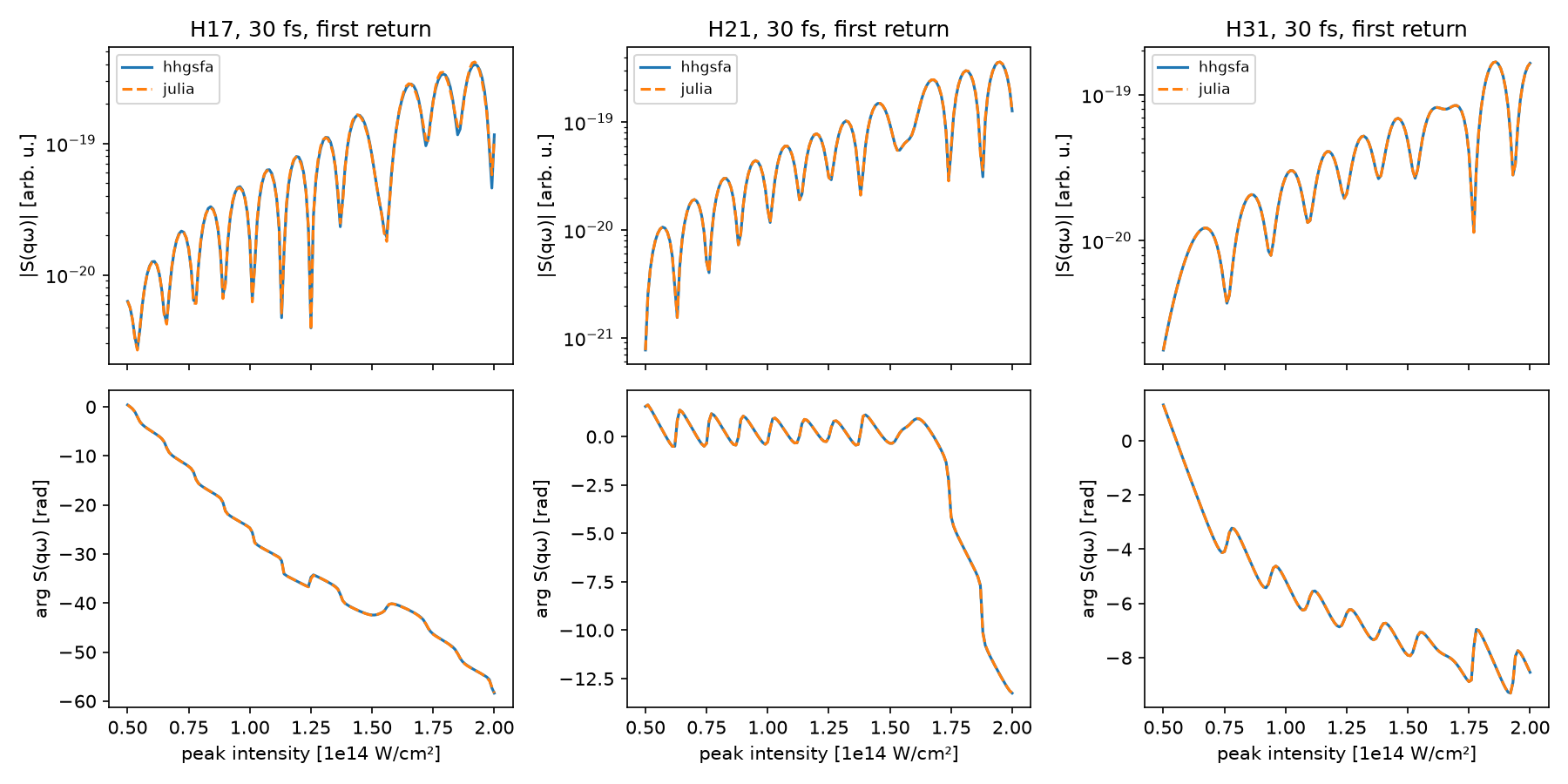
Harmonics 17, 21 and 31 against the peak intensity, amplitude and phase.
Accuracy against the number of points per cycle, for a 10 fs pulse.
Run time of the dipole.
Running the benchmark#
The scripts are in benchmarks/sfa_jl. Install the Julia reference once, then run from the root of the repository.
julia --project=env -e 'using Pkg;
    Pkg.add(url="https://github.com/jagot/StrongFieldApproximation.jl", rev="835080b");
    Pkg.add(["ElectricFields", "Unitful", "UnitfulAtomic", "NPZ"])'
JULIA_PROJECT=env uv run --extra numba --with matplotlib python benchmarks/sfa_jl/run.py
Tables#
Julia compile time 3.3 s (excluded below).
Accuracy#
window |
points per cycle |
hhgsfa, own convergence |
julia, own convergence |
between codes |
between codes, phase [rad] |
|---|---|---|---|---|---|
first return |
128 |
5.0e-05 |
2.7e-02 |
1.2e-01 |
3.6e-02 |
first return |
256 |
8.2e-06 |
1.1e-02 |
1.3e-01 |
4.0e-02 |
first return |
512 |
7.5e-07 |
4.0e-03 |
1.4e-01 |
4.2e-02 |
first return |
1024 |
reference |
reference |
1.4e-01 |
4.3e-02 |
every return |
128 |
5.3e-04 |
5.3e-04 |
1.9e-05 |
2.7e-05 |
every return |
256 |
1.6e-04 |
1.6e-04 |
1.2e-06 |
1.7e-06 |
every return |
512 |
reference |
reference |
7.4e-08 |
1.1e-07 |
Run time#
Measured on 13th Gen Intel(R) Core(TM) i7-13700, 24 logical cores.
case |
time points |
julia, 1 thread [s] |
hhgsfa numpy [s] |
hhgsfa numba, 1 thread [s] |
hhgsfa numba, 24 threads [s] |
|---|---|---|---|---|---|
10 fs, first return, 128 pts/cycle |
1491 |
0.21 |
0.012 (×18) |
0.003 (×82) |
0.001 (×292) |
10 fs, first return, 256 pts/cycle |
2981 |
0.88 |
0.052 (×17) |
0.012 (×75) |
0.003 (×316) |
10 fs, first return, 512 pts/cycle |
5961 |
3.66 |
0.189 (×19) |
0.045 (×80) |
0.011 (×330) |
10 fs, first return, 1024 pts/cycle |
11922 |
15.03 |
0.641 (×23) |
0.160 (×94) |
0.038 (×393) |
10 fs, every return, 128 pts/cycle |
1491 |
1.29 |
0.122 (×11) |
0.019 (×67) |
0.005 (×244) |
10 fs, every return, 256 pts/cycle |
2981 |
5.41 |
0.445 (×12) |
0.072 (×75) |
0.024 (×224) |
10 fs, every return, 512 pts/cycle |
5961 |
22.24 |
1.742 (×13) |
0.221 (×101) |
0.086 (×258) |
Harmonic contrast, 30 fs at 1.5e14 W/cm²#
Amplitude of each harmonic over the larger of its two even neighbors.
window |
code |
H17 |
H19 |
H21 |
H31 |
H41 |
|---|---|---|---|---|---|---|
first return |
hhgsfa |
0.6 |
0.9 |
1.0 |
1.2 |
1.1 |
first return |
julia |
0.7 |
1.0 |
1.0 |
1.2 |
1.1 |
every return |
hhgsfa |
0.7 |
0.6 |
0.3 |
1.0 |
1.1 |
every return |
julia |
0.7 |
0.6 |
0.3 |
1.0 |
1.1 |