Propagation#
Setup#
The SLM sits at a distance \(L\) in front of a lens of focal length \(f\). In the back focal plane, the field is the Fourier transform (FT) of the field on the SLM, times a curvature [1],
with the unitary FT \(E(k_X, k_Y) = \frac{1}{2\pi} \iint E(X, Y)\, e^{-i(k_X X + k_Y Y)}\, \mathrm{d}X\, \mathrm{d}Y\). The constant phase \(e^{ik(f + L)}\) is left out. The curvature vanishes only when the SLM sits in the front focal plane, \(L = f\), the default. Over a single focus it is small, but across a pattern of several foci or a ring it is not.
Functions#
function |
gives |
method |
|---|---|---|
|
the coordinates in the back focal plane |
|
|
the field on (x, y) |
FFT of the padded SLM |
|
the field after free propagation, in one plane or a scan in z |
angular spectrum |
focus evaluates the FT by one FFT of the SLM field, zero-padded to \(N \times N\). focus_grid sets \(N\), pad times
the number of points n of the SLM, 2 by default, and keeps the n samples around the axis. Their pitch is
\(\lambda f/(Np)\) for pixels of pitch \(p\). With pad=2, the window is the central half of the plane the SLM reaches,
\(\lambda f/p\). With pad=1, it is the whole plane at twice the pitch. focus reads \(N\) back from the pitch of x, so
the padding is chosen once. It raises an error if x is not a focal grid of X at this wavelength and focal length.
focus_grid(..., window=a) keeps only a square of side a around the axis, and focus then gives the field on that
window only.
free uses the exact transfer function \(e^{iz(k_z - k)}\), beyond the paraxial approximation, on a fixed periodic grid.
Keep the field away from the edges of the grid over the whole propagation.
Other planes#
To follow the beam through the focus, compute focus on a window of the focal grid around the beam, and give it to
free with an array of z, measured from the back focal plane. It costs one inverse FFT per plane. The part kept
must hold the beam over the whole scan.
Example#
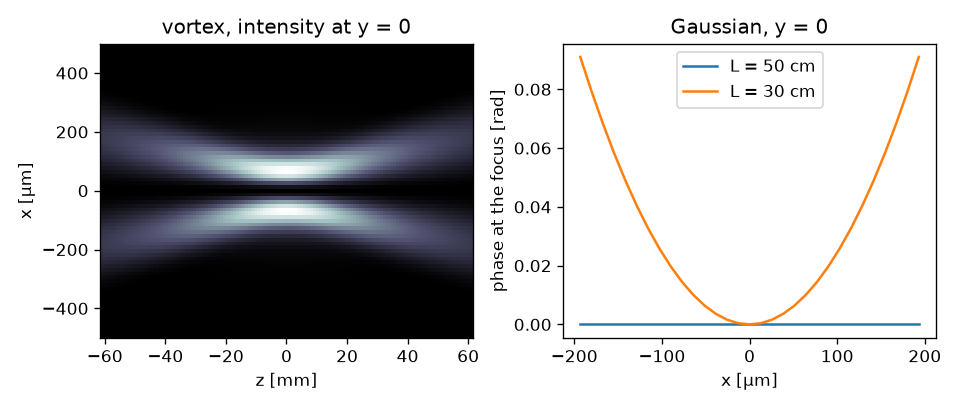
Left, a vortex of charge 1 through the focus, by focus and free. Right, the phase of a Gaussian focus for two
distances from the SLM to the lens. It is flat for \(L = f\) and curved otherwise.
import matplotlib.pyplot as plt
import numpy as np

import fourierslm as fs

lam, f, w = 1030e-9, 0.5, 2e-3
X, Y = fs.slm_grid(size=10 * w)
x, y = fs.focus_grid(X, Y, lam, f)
intensity = fs.intensity.gaussian(X, Y, w)
z_R = lam * f**2 / (np.pi * w**2)

u, _ = fs.focus_grid(X, Y, lam, f, window=2e-3)  # ±1 mm around the axis
E_slm = fs.slm_field(intensity, fs.phase.vortex(X, Y, 1)).astype(np.complex64)
z = np.linspace(-3, 3, 121) * z_R
scan = fs.propagate.free(fs.propagate.focus(E_slm, X, Y, u, u, lam, f), u[1] - u[0], lam, z)

fig, ax = plt.subplots(1, 2)
ax[0].imshow(np.abs(scan[:, len(u) // 2, :]).T ** 2, extent=[z[0] * 1e3, z[-1] * 1e3, u[0] * 1e6, u[-1] * 1e6],
             aspect="auto", origin="lower")
ax[0].set(xlabel="z [mm]", ylabel="x [µm]", title="vortex, intensity at y = 0", ylim=(-500, 500))
for L in (f, 0.3):
    E_focus = fs.propagate.focus(fs.slm_field(intensity, 0), X, Y, x, y, lam, f, slm_distance=L)
    row, near = E_focus[len(y) // 2], np.abs(x) <= 200e-6
    ax[1].plot(x[near] * 1e6, np.angle(row[near] / row[len(x) // 2]), label=f"L = {L * 100:.0f} cm")
ax[1].set(xlabel="x [µm]", ylabel="phase at the focus [rad]", title="Gaussian, y = 0")
ax[1].legend()
fig.tight_layout()
References#
J. W. Goodman, Introduction to Fourier Optics, 2nd ed., McGraw-Hill (1996), Eq. (5-19).